
TSW202 Giteki: Difference between revisions
Created page with "right|160px The '''Japan Radio Law''' covers all products which utilize the radio spectrum and operate under 3 THz. Specified Radio Equipment Devices..." |
No edit summary |
||
| (One intermediate revision by the same user not shown) | |||
| Line 1: | Line 1: | ||
[[File:GITEKI_LOGO.png|right|160px]] | [[File:GITEKI_LOGO.png|right|160px]] | ||
'''JATE''' provides technical conditions compliance certifications for the telecommunications terminal equipment. It promotes the development, standardization and reliability of telecommunications network and smooth installations of terminal equipment. We will have been contributing to the evolution of telecommunications systems. | |||
__TOC__ | __TOC__ | ||
==Description== | ==Description== | ||
This certification | JATE certification is a telecommunications equipment compliance certification. This certification is for communications equipment in Japan, ensuring that the equipment meets the Japanese "Electric Communications Business Law". All wireless products connected to public phones or telecommunications networks must apply for JATE certification. In simple terms, JATE certification is a Japanese access certification. | ||
JATE certification is a compulsory certification for Japanese public network telecommunications equipment. The Japanese Ministry of Public Administration and Interior, Post and Telecommunications (MPHPT) stipulates in the Japanese Telecommunications Business Law that compulsory certification of Japanese telecommunications equipment is implemented. Telecommunications commercial law was established in 1985, and Article 68 states that MPHPT authorizes qualified agencies to implement the qualification of technical conditions. | |||
MPHPT authorizes JATE (Japan Approvals Institute for Telecommunications Equipment) as a qualified agency to implement qualification accreditation, so we are accustomed to calling Japan Telecom Equipment Certification the JATE certification. JATE approval requires the certification mark to be affixed to the product, and the certification mark uses the serial number. Approved products, applicants, products, certification numbers and other relevant information will be announced on the government bulletin and JATE's website. | |||
Generally speaking, telecommunications products entering the Japanese market must meet the testing requirements of Japan's Telecommunications Law (JATE certification) and Radio Waves Law (TELEC certification). | |||
==TSW202 Certification numbers== | ==TSW202 Certification numbers== | ||
| Line 28: | Line 34: | ||
<li>[http://www.jate.or.jp/ Japan Approvals Institute for Telecomunications Equipment (JATE)]</li> | <li>[http://www.jate.or.jp/ Japan Approvals Institute for Telecomunications Equipment (JATE)]</li> | ||
<li>[https://www.tele.soumu.go.jp/e/sys/equ/tech/index.htm MIC website]</li> | <li>[https://www.tele.soumu.go.jp/e/sys/equ/tech/index.htm MIC website]</li> | ||
<li>[https://www.jate.or.jp/english/outline/outline.html JATE description website]</li> | |||
</ul> | </ul> | ||

Latest revision as of 09:45, 31 December 2024
TSW202 Certification & Approvals > TSW202 Giteki
JATE provides technical conditions compliance certifications for the telecommunications terminal equipment. It promotes the development, standardization and reliability of telecommunications network and smooth installations of terminal equipment. We will have been contributing to the evolution of telecommunications systems.
Description
JATE certification is a telecommunications equipment compliance certification. This certification is for communications equipment in Japan, ensuring that the equipment meets the Japanese "Electric Communications Business Law". All wireless products connected to public phones or telecommunications networks must apply for JATE certification. In simple terms, JATE certification is a Japanese access certification.
JATE certification is a compulsory certification for Japanese public network telecommunications equipment. The Japanese Ministry of Public Administration and Interior, Post and Telecommunications (MPHPT) stipulates in the Japanese Telecommunications Business Law that compulsory certification of Japanese telecommunications equipment is implemented. Telecommunications commercial law was established in 1985, and Article 68 states that MPHPT authorizes qualified agencies to implement the qualification of technical conditions.
MPHPT authorizes JATE (Japan Approvals Institute for Telecommunications Equipment) as a qualified agency to implement qualification accreditation, so we are accustomed to calling Japan Telecom Equipment Certification the JATE certification. JATE approval requires the certification mark to be affixed to the product, and the certification mark uses the serial number. Approved products, applicants, products, certification numbers and other relevant information will be announced on the government bulletin and JATE's website.
Generally speaking, telecommunications products entering the Japanese market must meet the testing requirements of Japan's Telecommunications Law (JATE certification) and Radio Waves Law (TELEC certification).
TSW202 Certification numbers
- Construction Type Certificate marking [T] No.: D24-0024018
Device Approvals
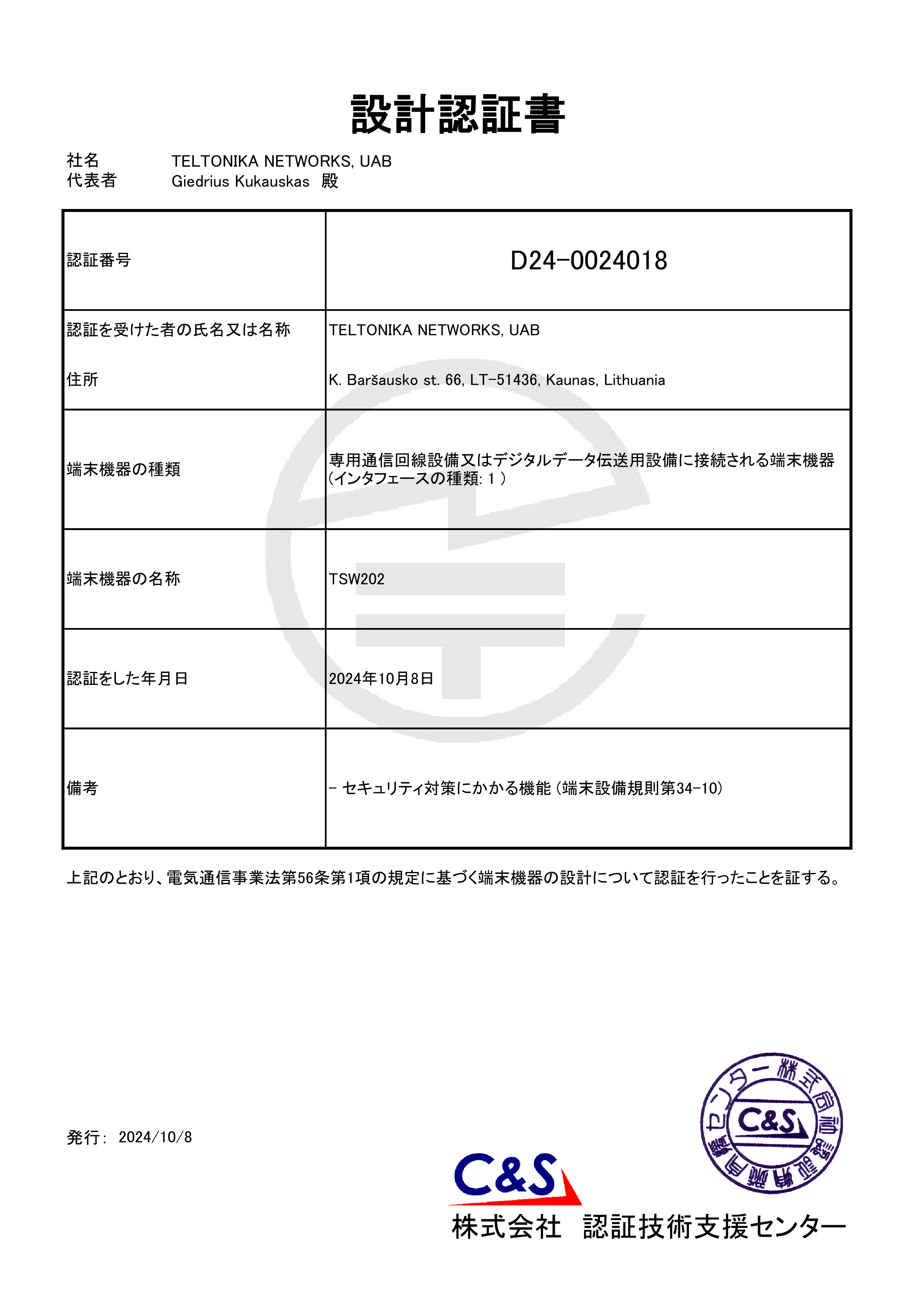 |
To download a PDF version of the declaration for: TSW202 JATE Certificate.
External links
- Japan Approvals Institute for Telecomunications Equipment (JATE)
- MIC website
- JATE description website
Disclaimer:
Test reports that are referenced in declarations and certificates can be provided upon request. For the request to be approved, the recipient of the test reports should be a certification authority or certified test house. The recipients will be asked to sign a non-disclosure agreement (NDA).